Machine builder bent
on keeping quiet
A manufacturer of tube bending machines reveals some of their secrets of success - including how they made deep cuts in noise generation.
By A. L. Hitchcox, managing editor
When it comes to framing members and other structural elements for cars and other trucks, hydroforming is where it's at. Hydroforming starts with a tube - generally carbon steel - that has been pre-bent into a three-dimensional shape that will fit into a closed die. Fluid is then pumped into the tube, high pressure is applied to the fluid, and the pressure applies uniform stress to the inner surface of the tube. The tube undergoes plastic deformation, expands, and assumes the shape of the die's interior surface. This is no light-duty task, considering that tubing typically has an OD of 1/2 to 6 in. with a wall thickness of 0.020 to 0. 120 in. Pressure is then relieved, the fluid drained, the formed part ejected, and preparations are made for the next workpiece.
To pre-bend tubing so it will fit into a die, many OEMs rely on tube-bending machines designed and built by Eagle Precision Technologies Inc., Brantford, Ontario. Eagle Precision also has a line of end forming and muffler-assembly machines. Their end-forming machines perform such tasks as forming a flared or tapered tube end or expanding the ID at the end of one tube so it will mate with another tube of the same size. The muffler assembly machines combine bending, end forming, roll forming and joining, pressing, and cutting (not necessarily in that order) to form mufflers from steel tubing sheet. All three types of machines are used extensively for making exhaust system parts for cars - both at the OEM level and for the huge exhaust aftermarket.
But Eagle's machines certainly are not limited to just automotive applications or to working with tubing that has a round cross section. At the low end of the scale are machines for bending, end forming, and cutting of 1/2 in. diameter tubing that may become hydraulic tubing assemblies for aircraft, marine vessels, off-highway equipment, or similar end uses. The finished assemblies may instead use square tubing to serve as a single-piece frame for a kitchen chair or fabricated into a heavy-duty assembly for office chairs. Or high-grade steel tubing may be used for precise heat exchanger tubes in refrigeration, furnaces, chemical processing, and other demanding applications. In the ever-growing health and fitness industry, manufacturers of treadmills and other exercise equipment use Eagle Precision's machines for producing strong but lightweight tubular frames made from a variety of materials and cross-sectional shapes, even extruded shapes.
Machine anatomy
Jim Sabine, engineering manager at Eagle Precision, reveals, "We use our own CNC control based on a VME bus computer system and write our own software. Bending is a high-level program: you enter the physical parameters of the tube you're starting with, the basic shape of the tube you want, and the controller takes over from there. The software then factors in the tubing material's properties, size, and thickness, and executes the bend at optimum speed.
"For some materials, such as Inconnel, bending must occur slowly to avoid ripping them. However, because metals work harden as they bend, you can't go too slow. Plain carbon steel, on the other hand, can be bent at much higher rates. That's why we have to use servovalves: we must generate extremely high forces at high speed, yet maintain positional accuracy within thousandths of an inch."
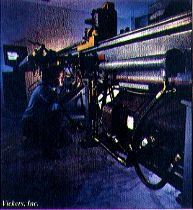
Bending machine uses enclosed pump-motor assembly mainly for quiet operation but also benefits from positive side effects. |
|